

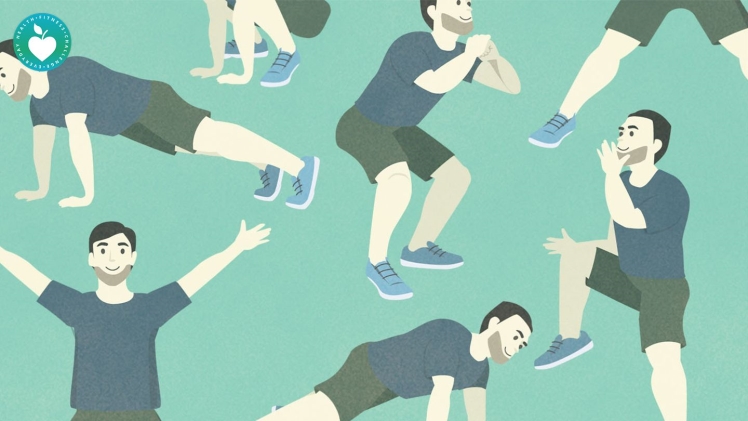
Exercise is essential for optimum health. However, we tend to confine ourselves to one or two kinds of activities. “People are doing what they enjoy or what they feel most successful, so that some components of exercise and physical fitness are not taken into account,” says Rachel Wilson, a physical therapist at the Brigham and Women’s Hospital of Harvard. We should all do aerobics, stretch, strengthen and balance. Here, we detail everything you need to know about each exercise and provide examples to practice with a doctor for fitness.
1. Aerobics
Aerobic exercise, which speeds up your heart rate and breathing, is crucial for many biological functions. It offers your heart and lungs training and increases stamina. “If you’re over-winded to climb an escalator flight, this is a good indication of a need for greater aerobic activity to assist your heart and lungs grow and deliver enough blood to your muscles to help them perform efficiently,” Wilson adds.
Aerobic workout also helps to relax the blood vessel walls, lower blood pressure, lower blood sugar levels, lower inflammation, promote mood, and increase “good” HDL cholesterol. Combined with weight loss, “bad” LDL cholesterol can also be lower. Aerobic exercise will reduce your risk of heart disease, stroke, type 2 diabetes, breast and colon cancer, depression, and falls over the long term.
Target moderate-intensity activity for 150 minutes each week. Try to walk, swim, jog, bike, dance or take lessons like step aerobics.
2. Training Strength
COVID-19 Series of Clinical Education: Clarification of evidence-based information
The impact of COVID-19 is amplified by health disparities and misunderstandings about the prevention and treatment of diseases. This video series is a cooperation between the Harvard Medical School and various members of the scientific community that provides timely, precise, and evidence-based COVID-19 information to a global audience of healthcare.studio.
A physical therapist can build an exercise regimen that you can undertake in a gym, at home, or work two to three times a week. It may involve bodyweight workouts such as squats, push-ups, lunges, and exercises with weight, band, or weight resistance.
“Remember that at the end of the workout, it is vital to feel muscle tired to make sure you work or train the muscle group efficiently,” explains Wilson.
3. Extension
The extension helps to preserve flexibility. We often ignore that when our muscles are healthier in young people. However, aging leads to a decrease in strength and tendon flexibility. Muscles are shortened and don’t work correctly. This raises the chance of muscle cramps and soreness, damage to your forces, stresses, joint pain, and decay, and it also makes it hard to do everyday actions like bending down to tie your shoes.
Also, stretching the muscles routinely increases their flexibility and expands their range of motion, and minimizes the chance of injury and pain.
4. Balance training
Improving your balance makes you feel more stable and helps you prevent falling. It is especially vital as we become older because our systems — our vision, our inner ear, and our leg muscles and joints — tend to wear down. “Training your balance can help avoid and reverse these losses,” Wilson explains.
Many elder centers and sports facilities provide balanced training sessions, such as tai chi or yoga. It’s never too early to begin this kind of workout, even if you feel you have no balancing problems.
You can also go to a physical therapist who determines your present equilibrium skills and prescribes particular workouts to address your weaker areas. “That’s particularly significant if you had a fall or a precipitation, or if you’re afraid of falling,” Wilson explains.
Typical balancing exercises are to stand on one foot or to go to your toe with open or closed eyes. You can also concentrate on joint flexibility, walk on uneven surfaces and build leg muscles with workouts such as squats and leg lifts. Get the proper training at home before trying any of these activities.
